

 Posts


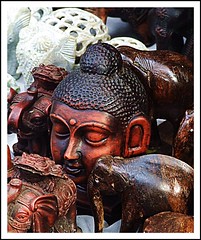


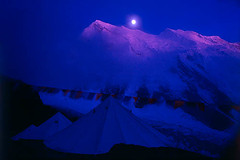
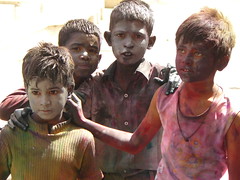

This show was taken from Khera Deogarh, Rajasthan, India

Rickshaw - originally a Japanese concept meaning human powered vehicle was introduced in Kolkata by Chinese immigrants in the 19th Century. It continues in the modern age despite it degrading the human values in one man pulling another.

Monks in Lingshed gompa in Ladakh.

a Buddhist monk, between prayers
bodhgaya, bihar.

Chidambaram - Tamil Nadu - South India.
At the bottom of the East gopuram , main entrance of the Shiva Nataraja Temple (see previous picture), is a little shrine dedicated to Ganesha (Pillayar in Tamil).
At night fall, this gopuram is enlightened by huge floodlights (godsends for a non - SLR digital camera, therefore very noisy at 400 asa!

I followed this man as he wobbled along the rural back roads near Chidamburam stopping along the way to sell his brightly coloured wares.

Pahar Ganj has its fair share of parades and festivals. This one seemed to be connected with Sai Baba and some of Delhi's best bands were taking part

Kambala is traditionally a buffalo race. The 'track' used for Kambala is a paddy field filled with slush. The contest generally takes place between two pairs of buffaloes, controlled by a whip-lashing farmer.

Pondicherry - Union Territory of Pondicherry - South India.
Goubert, or Big Market. Nehru Street.
A market is often a magic place, with so many colors and smells, with his high in colour sellers and customers; So is the Poncherry market.
With its blue and yellow plastic hangings under the sun, the light is great.
Its very nice to have a stroll here, talking, and taking pictures...

The painted elephant getting ready to take someone on a joyride in the pinkcity with the Hawa Mahal in the background and the rickshawallahs epitomise what is essentially Jaipur.

Wooden boats in renewing in Veraval harbour. These boats are all wood builded. Some poor people like this woman come here to get some pieces of wood for cooking.

Returning from a day of hard work, carrying fire wood as fuel for cooking at home. This shot was taken from goa.

"I work 15 hours a day.
Get no insurance or sick days.
I have no savings and no home. Do you still think your life isn't that good enough?"

Kottackal Chandra Sekharan performs as Dharmaputhrar in "GANDHARI VILAPAM "
Kathakali: (Malayalam: കഥകളി, pronounced [kət̪ʰəkəɭi]) is a highly stylised classical Indian dance-drama noted for its attractive make-up of characters, their elaborate costumes, detailed gestures and well-defined body movements presented in tune with the anchor playback music and complementary percussion. It originated in the country's southern state of Kerala during the 16th century AD, approximately between 1555 and 1605, and has been updated over the years with improved looks, refined gestures and added themes besides more ornate singing and precise drumming ./wikipedia/

Just trying out a crop of my original posted here earlier...
This man is taking the old woman across the small canal. The canal is used for water transport and I was in a boat passing through this canal when I shot this one.
Shot on Kottayam Alleppey boat ride, Dec 30, 2008

Congress Party supporters, during the Lok Sabha Election Rally, at MMRDA Grounds, Mumbai, India, April 26, 2009.
Congress lead UPA won again in the election.

Guru Nanak Dev (20 October1469– 22 September 1539), was the founder of Sikhism and the first of the ten Gurus of the Sikhs. Nanak was born in a Bedi family of Hindu Khatri clan, in the village of Rāi Bhōi , now called Nankana Sahib, near Lahore (in present-day Pakistan)
He is revered not only by Sikhs, but also by Hindus and Muslims in the Punjab and across the Indian subcontinent His primary message to society was recorded to be"devotion of thought and excellence of conduct as the first of duties"
Guru Nanak’s birthday as per Hindu calender was celebrated yesterday.Here Hindu and Sikh devotees are lighting candles at Bangla Sahib Gurdwara(Temple

On january 1st, I went away from Mysore to Brindavan, a 20 km walk, with a group of 8 women Sadhus. It's still night time. Before leaving, we went to a Jain temple where they prayed before leaving.

Allium sativum L., commonly known as Garlic, is a species in the onion family Alliaceae. Garlic has been used throughout history for both culinary and medicinal purposes. It has a characteristic pungent, spicy flavor that mellows and sweetens considerably with cooking.
Garlic is easy to grow and can be grown year-round in mild climates. In cold climates, cloves can be planted in the ground about six weeks before the soil freezes and harvested in late spring. Garlic plants are not attacked by pests.
China is the largest producer of garlic, with approximately 10.5 billion kilograms (23 billion pounds) annually, accounting for over 77% of world output. India (4.1%) and South Korea (2%) follow, with Russia (1.6%) in fourth place and the United States (where garlic is grown primarily as a cash crop in every state except for Alaska) in fifth place (1.4%).
Garlic's medicinal properties are already proved in folk medicine. The consumption of garlic n smashed or crushed form (without cooking too much) can be effective for fighting cancer & against cholesterol. It has a proven track record as a good anti oxidant. Allicin, a chemical compound present in Garlic has been an effective anti biotic and anti fungal. Apart from all these, its an excellent mosquito repellent.
In Kerala, Munnar in idukki is the only place you can find garlic farming and this beautiful lady was all happy to show n explain us about the Golden wonder.

two children sharing turns standing on either pedals weaving through the alleys.
cuttack, india

Amber Fort (Hindi: आमेर किला, also known as Amer Fort) is located in Amber, 11 km from Jaipur, Rajasthan state, India. It was the ancient citadel of the ruling Kachhawa clan of Amber, before the capital was shifted to present day Jaipur. Amber Fort is known for its unique artistic style, blending both Hindu and Muslim (Mughal) elements, and its ornate and breathtaking artistic mastery.[1] The fort borders the Maota Lake, and is a major tourist attraction in Rajasthan.
Amber was originally built by the Meenas in the town they consecrated to Amba, the Mother Goddess, whom they knew as `Gatta Rani' or `Queen of the Pass' [ Tod.II.282 ]. Built over the remnants of an earlier structure, the palace complex which stands today was commenced under the reign of Raja Man Singh, Commander in Chief of Akbar’s army and a member of the Emperor's inner circle of nine courtiers, in 1592. The initial structure of the fort was entirely completed by his descendant, Jai Singh I.[3] Amber was modified by successive rulers over the next 150 years, until the Kachwahas shifted their capital to Jaipur during the time of Sawai Jai Singh II.
(Source Wikipedi)
Here elephants waiting for Tourists at Amer Palace.

he lived in bihar.. has shifted to kolkata to find atleast a minimum job.. finally he works as a clay-bearer.. transfers it from one place to another... after an another tiresome work, he was resting. that moment i caught him..
em-bypass area, kolkata, india


MDG4 & MDG8 - Reduce Child Mortality and Global Partnership.. I merged both of those goals into this.
Target 4a: Reduce by two thirds the mortality rate among children under five
* 4.1 Under-five mortality rate
* 4.2 Infant mortality rate
* 4.3 Proportion of 1 year-old children immunised against measles
Target 8a: Develop further an open, rule-based, predictable, non-discriminatory trading and financial system
Includes a commitment to good governance, development and poverty reduction – both nationally and internationally
Target 8b: Address the special needs of the least developed countries
Includes: tariff and quota free access for the least developed countries' exports; enhanced programme of debt relief for heavily indebted poor countries (HIPC) and cancellation of official bilateral debt; and more generous ODA for countries committed to poverty reduction
Target 8c: Address the special needs of landlocked developing countries and small island developing States (through the Programme of Action for the Sustainable Development of Small Island Developing States and the outcome of the twenty-second special session of the General Assembly)
Target 8d: Deal comprehensively with the debt problems of developing countries through national and international measures in order to make debt sustainable in the long term
Some of the indicators listed below are monitored separately for the least developed countries (LDCs), Africa, landlocked developing countries and small island developing States.
Official development assistance (ODA)
* 8.1 Net ODA, total and to the least developed countries, as percentage of OECD/DAC donors’ gross national income
* 8.2 Proportion of total bilateral, sector-allocable ODA of OECD/DAC donors to basic social services (basic education, primary health care, nutrition, safe water and sanitation)
* 8.3 Proportion of bilateral official development assistance of OECD/DAC donors that is untied
* 8.4 ODA received in landlocked developing countries as a proportion of their gross national incomes
* 8.5 ODA received in small island developing States as a proportion of their gross national incomes
Market access
* 8.6 Proportion of total developed country imports (by value and excluding arms) from developing countries and least developed countries, admitted free of duty
* 8.7 Average tariffs imposed by developed countries on agricultural products and textiles and clothing from developing countries
* 8.8 Agricultural support estimate for OECD countries as a percentage of their gross domestic product
* 8.9 Proportion of ODA provided to help build trade capacity
Debt sustainability
* 8.10 Total number of countries that have reached their HIPC decision points and number that have reached their HIPC completion points (cumulative)
* 8.11 Debt relief committed under HIPC and MDRI Initiatives
* 8.12 Debt service as a percentage of exports of goods and services
Target 8e: In cooperation with pharmaceutical companies, provide access to affordable essential drugs in developing countries
* 8.13 Proportion of population with access to affordable essential drugs on a sustainable basis
Target 8f: In cooperation with the private sector, make available the benefits of new technologies, especially information and communications
* 8.14 Telephone lines per 100 population
* 8.15 Cellular subscribers per 100 population
* 8.16 Internet users per 100 population

He is a sugarcane juice seller. he and his wife spend almost all of their evenings there selling this.
super nice taste. .. wonder what else they d o for their livelihood in the day times.. ;
one interesting point i found about sugarcane sellers in hyd.. they give some wonderful juice but then if there is no electricity then there is no juice..
Subscribe to:
Posts (Atom)